Criminals don't need to hack you if your information is already online.
The breach may have happened years ago. The damage can happen tomorrow.
- —Exposed passwords
- —Phone numbers
- —Home addresses
All can be used to open credit in your name, access your accounts, or impersonate you.
InfoTrace finds what's exposed and shows you how to remove it.
This isn't a rare event. It happens to ordinary people every day.
These are not statistics about companies being hacked. These are statistics about real people — people who had their money stolen, their identity used without permission, and their lives disrupted for months.
We find everything
linked to your name that's already out there — and tell you exactly what to do about it.
We uncover what's exposed, explain the risks, and give you a clear plan to secure it.
Tell us about yourself
Give us your name, email address and phone number. We use them to identify information linked to you across breach databases and public records.
We investigate
A cybersecurity professional searches every breach database, people-search site, and public record linked to you — then reads every result and decides what genuinely puts you at risk.
You get your report
A prioritised, human-written action plan within 36 hours. What was found, what it could be used for, and exactly what to do about each one.
Could You Be Exposed?
Most people check at least three.
If you've used any of these, your data has likely been leaked.
These are real data breaches from the last five years — apps and services used by hundreds of millions of ordinary people. When these services were hacked, your personal information went with them. And it's still out there.
Phone numbers, real names and locations for over 530 million accounts were published freely online.
530 million people affectedProfile data from 700 million accounts — covering more than 90% of all LinkedIn users — was posted on a dark web forum.
700 million people affectedEmail addresses and phone numbers were matched to accounts, allowing anyone to link a username to a real identity.
200 million people affectedPhone records for approximately 110 million customers were stolen, exposing who called who, when, and from which location.
110 million people affectedNames, home addresses and partial payment card details were stolen and put up for sale on the dark web.
560 million people affectedNames, addresses, dates of birth and account details for over 37 million customers were stolen via an API vulnerability.
37 million people affectedFinancial account details — including portfolio values, holdings and trading activity — were downloaded by a former employee and exposed.
8 million people affectedNames, birth years, locations, family connections and ethnicity estimates were exposed. This is information that cannot be changed the way a password can.
6.9 million people affectedA background-checking company that collected personal data without consent. Social security numbers, addresses, emails and phone numbers were dumped freely online. You never signed up — your information was there anyway.
270 million people affectedSomeone already knows more about you than you think.
Not in one dramatic hack. Through small pieces of information — gathered from different places, combined into something dangerous. This is how it happens.
- Your bank accounts emptied — sometimes overnight
- Loans and credit cards opened in your name without your knowledge
- Your tax refund intercepted before you file
- Criminal activity recorded under your identity
- Months — often years — spent proving who you are, with no guarantee of full recovery
InfoTrace finds the pieces of your information that are already out there — before someone collects them and puts them together.
Find out what's already out there →Three types of information that put you at risk.
Starting from your name and email address, we follow every thread we can find — across breach databases, public records and data broker sites.
Information used to access your accounts
Leaked passwords and login details that could still work today — on your email, bank, or any account that shares the same credentials.
Information used to impersonate you
Old profiles, usernames and accounts that can be linked back to your real identity — giving someone enough to pose as you to a bank, employer, or government service.
Information used to target you
Addresses, phone numbers and personal details collected and sold by data brokers — used to build a profile of where you live, who you know, and how to reach you.
This is the part where we get technical — because understanding how breaches work is the reason our analysis goes deeper than a free checker.
We identify whether your email-password pairs appear in combolists actively used for automated login attacks across thousands of sites simultaneously.
Not all breached passwords are encrypted equally. We flag where yours were stored in plaintext or in weakly-hashed formats that have since been cracked and published.
We cross-reference your identifiers across multiple breach databases — including stealer logs, dark web forums and paste sites — to build a complete picture of your credential exposure.
We assess which breached passwords are likely still active on your accounts today, and rank them by the severity of what an attacker could access if those accounts were compromised.
A prioritised report. Every finding explained. A step-by-step action plan.
Not a raw list of search results. A human-written report that tells you what's out there, how serious each piece is, and what to do about it first. Delivered within 36 hours.
What people found out about themselves.
"I assumed I had a pretty light online presence. InfoTrace found my personal details in eight separate breaches, including a password I was still using on my email account. The report told me exactly what to do and in what order. Delivered in under 24 hours — sorted within a week."
"I'm reasonably tech-savvy and thought I had a handle on my digital footprint. I didn't. InfoTrace found login credentials from a breach I never received a notification about — still active on accounts I use every day. Report delivered in under 24 hours."
"I signed up after a friend had money taken from her bank account. InfoTrace found my email and password in four separate breach databases — one matched credentials I was still actively using. The report showed exactly how serious it was and what to do first."
"Every finding in the report came with a clear explanation of the actual risk and exactly what to do. Three data broker listings were removed on my behalf within a week. Far more thorough than anything I could have done myself."
"I was sceptical but wanted peace of mind. InfoTrace found my full name, home address and date of birth combined on a site I'd never heard of, alongside a phone number that still forwards to mine. Genuinely alarming — and genuinely useful."
"I'd run a free breach check before and it flagged two results. InfoTrace found seven, including one that contained my National Insurance number. The difference in depth is hard to overstate."
"I wanted to know exactly what someone could find out about me if they looked. InfoTrace found my home address, phone number and workplace on three data broker sites I'd never heard of. Report back in under 24 hours. Genuinely eye-opening."
"I work in a public-facing role and was concerned about what was out there. InfoTrace found old profiles, an address from seven years ago still listed, and credentials from two breaches. The prioritised report made it clear what to deal with first."
"I'm not a tech person and was worried this would be complicated. It wasn't — I filled in a short form and had a clear, readable report in under 24 hours. The findings were alarming but the action plan made it manageable."
"I had no particular reason to worry — I just wanted to know. What InfoTrace found suggested I had plenty of reason to. Three breach databases, two people-search listings and an old forum account all linked back to my real name and home address."
"InfoTrace found accounts registered in my name on services I've never used. That was the part that alarmed me most — it suggested someone had already been active using my details. The report laid out exactly what it meant and what to do about each one."
"I had money taken from an account two years ago and always wondered how much of my information was still out there. InfoTrace answered that more thoroughly than I expected. Seven breaches, two data broker listings, and one finding that directly explained what had happened to me."
"I was cynical — assumed it would be a surface-level scan I could do myself. It wasn't. InfoTrace found things I wouldn't have known to look for, on sites I'd never have thought to check. Worth it purely for the peace of mind the report gave me."
"InfoTrace found my full name, age, address and estimated income on a people-search site I didn't know existed. The report explained exactly what data was there, how it got there, and included a removal request I could send directly."
"I ran the audit for my mother after she mentioned receiving calls from people who seemed to know too much about her. InfoTrace found her details on multiple data broker sites and in one breach. Having a clear report made it much easier to know how to help her."
Most customers discover information they didn't know was public.
One payment. The report is yours to keep. If we find nothing worth acting on, your payment is fully refunded.
Most discoveries find 5–20 instances of leaked personal information, several people-search listings and multiple linked accounts.
- Full search of breaches, people-search sites, old accounts and public images
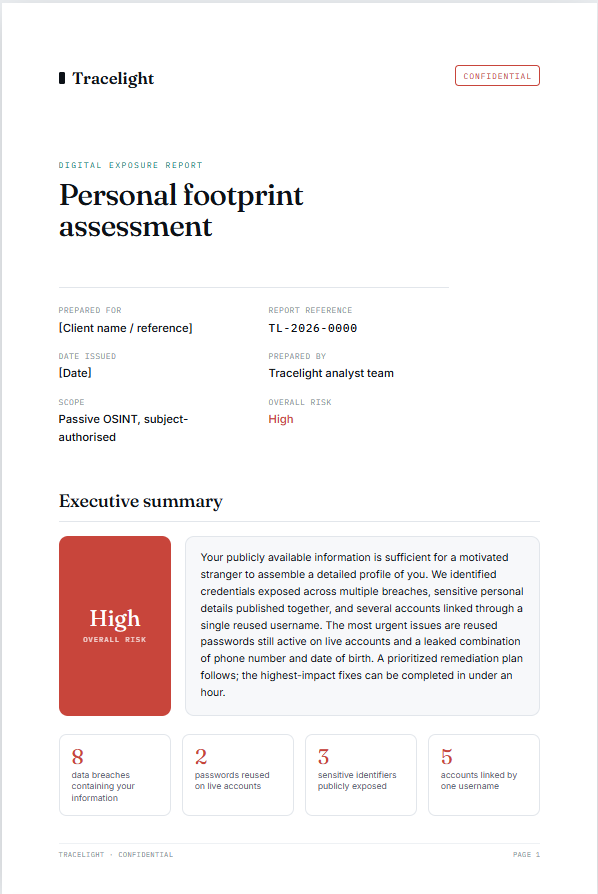
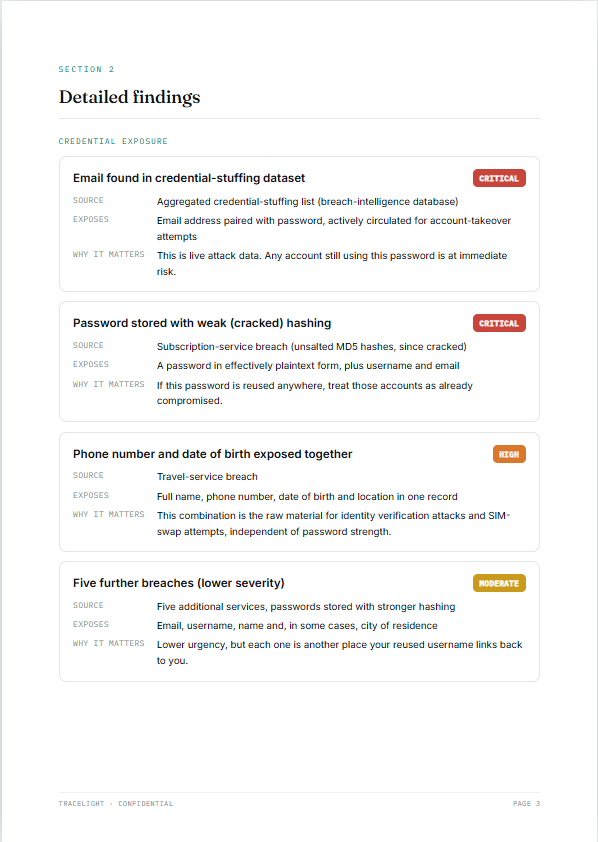
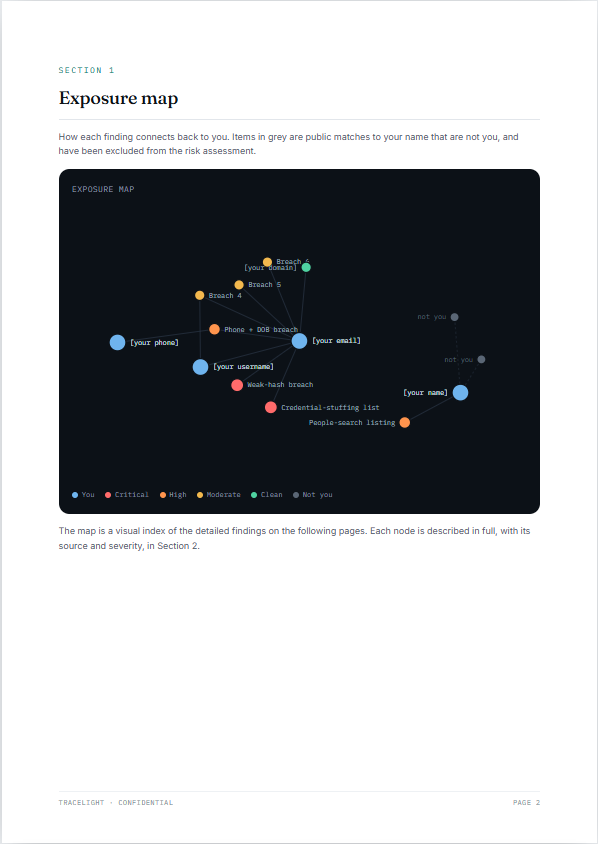
- Map of everything found, colour-coded by risk
- Plain-language explanation of what each finding means for you
- Full refund if nothing worth acting on found
Typically saves 5–10 hours of contacting sites, disputing listings and tracking what's come down.
- Everything in Discovery
- Step-by-step action plan in priority order
- We contact people-search sites and request removal of your information using your legal rights
- Prioritised plan for information that can't be removed
- Follow-up check 30 days later to confirm what came down
- Full refund if nothing worth acting on found
- Deep investigation covering you and household members
- Done-for-you removal and protection
- Priority turnaround
- Direct line throughout the engagement
Removal requests use your statutory rights — UK and EU GDPR erasure, CCPA, California's Delete Act and the Australian Privacy Act. Most personal listings can be removed or suppressed. Information that has already spread through breaches often cannot be recalled, and is handled through your prioritised action plan instead. We submit removal requests; we cannot guarantee every site complies. California Delete Act broker processing applies from August 2026.
Everything you might be wondering.
Is this legal?
What if you don't find anything?
Is my information safe with you?
What do you need from me?
How fast will I get the results?
I'm not based in the US — does this still work?
Can I do this for a family member?
Someone already knows more about you than you think.
Find out what they can see before they use it. In 36 hours, you'll know exactly what's out there — and have a plan to stop it becoming a problem.
See what's already exposed about you →If we find nothing worth acting on, your payment is fully refunded.